
Open Reduction and Internal Fixation of the Ankle in Valhalla, NY
Open reduction and internal fixation (ORIF) of the ankle repairs a displaced or unstable ankle fracture by realigning the broken bones and securing them with surgical hardware. The goal is to restore alignment and stability while the fracture heals. Dr. Fred DeLucia, DPM, FACFAS, FACPM, is a dual board-certified foot and ankle surgeon specializing in reconstructive and trauma surgery. At Ankle and Foot Surgical Specialists in Valhalla, NY, he provides personalized care focused on improving ankle function and supporting recovery after injury.
What is Open Reduction and Internal Fixation of the Ankle?
Open reduction and internal fixation (ORIF) of the ankle is a surgical procedure performed to repair serious fractures (broken bones) of the ankle. It is performed on one or more of the three bones that form the ankle joint.
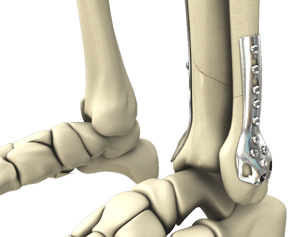
Open reduction refers to making an open incision (long surgical cut) to access the broken bones and reposition or realign them into their normal position. Internal fixation refers to utilizing fixation devices such as metal plates, screws, or rods to stabilize and hold the broken bones in place together while they heal.
The main objective of ORIF of the ankle is to correct the damaged structures to help reduce pain and restore mobility and natural function that has been lost due to injury or fracture.
Anatomy of the Ankle
The ankle joint is composed of three bones: the tibia, fibula, and talus, which articulate with each other. The ends of the fibula and tibia (lower leg bones) form the inner and outer malleolus, which are the bony protrusions of the ankle joint you can feel and see on either side of the ankle. The joint is protected by a fibrous membrane called a joint capsule and filled with synovial fluid to enable smooth movement.
Ankle fractures are very common in athletes and people engaged in physical work, often resulting in severe pain and impaired mobility. An ankle fracture is a painful condition, where there is a break in one or more bones forming the ankle joint. The ankle joint is stabilized by different ligaments and other soft tissues, which may also be injured during an ankle fracture.
Indications for Open Reduction and Internal Fixation of the Ankle
Open reduction and internal fixation of the ankle are indicated for the correction of ankle fractures that cannot be repaired with other treatment modalities such as pain medicines, physical therapy, manual manipulation, boots, casts, or braces. Your surgeon may recommend ORIF of the ankle for the following conditions:
- The ankle bone (s) has shattered into multiple pieces
- The fractured bone (s) is protruding out of the skin
- The fractured bone (s) is not aligned or lined up properly
- The ankle has become unstable
- The ankle is dislocated
- A prior closed reduction has not healed properly
Preparation for Open Reduction and Internal Fixation of the Ankle
In general, preoperative preparation for open reduction and internal fixation of the ankle will involve the following steps:
- A thorough examination is performed by your doctor to check for any medical issues that need to be addressed prior to surgery.
- Depending on your medical history, social history, and age, you may need to undergo tests such as blood work and imaging to screen for any abnormalities that could threaten the safety of the procedure.
- You will be asked if you have allergies to medications, anesthesia, or latex.
- You should inform your doctor of any medications, vitamins, or supplements that you are taking.
- You should refrain from supplements or medications such as blood thinners, aspirin, or anti-inflammatory medicines for 1 to 2 weeks prior to surgery.
- You should refrain from alcohol or tobacco at least a week before surgery.
- You should not consume any solids or liquids at least 8 hours prior to surgery.
- Arrange for someone to drive you home after surgery.
- A written consent will be obtained from you after the surgical procedure has been explained in detail.
Procedure for Open Reduction and Internal Fixation of the Ankle
In general, open reduction and internal fixation of the ankle will involve the following steps:
- You will be placed on the operating table in a specific position under spinal or general anesthesia.
- Your surgeon cleans the treatment area with an antiseptic solution and an incision is made through the skin and muscle of the ankle.
- The underlying muscles are carefully separated to expose the broken ankle bones.
- Your surgeon will meticulously realign or reposition the bones into their correct anatomical position (reduction).
- Next, your surgeon will employ fixation devices such as metal plates and other hardware to secure the fragments of your broken bones to each other (fixation) and stabilize them while they heal. An x-ray may be obtained after the devices are secured.
- Your surgeon may also carry out other repairs as necessary.
- The overlying soft tissue and skin are closed with sutures, and sterile bandages are applied.
- A splint or a cast is placed on the treatment area in order to protect the repair and facilitate healing.
Postoperative Care and Recovery
In general, postoperative care instructions and recovery after open reduction and internal fixation of the ankle will involve the following steps:
- You will be transferred to the recovery area where your nurse will closely observe you for any allergic/anesthetic reactions and monitor your vital signs as you recover.
- You may notice some pain, swelling, and discomfort in the ankle area. Pain and anti-inflammatory medications are provided as needed.
- Antibiotics are also prescribed to address the risk of surgery-related infection.
- Ice pack application to the affected area for 15-20 minutes helps to reduce postoperative pain and swelling.
- You should not weight-bear on the affected leg. A walking boot or non-weight-bearing cast is recommended for few weeks to facilitate healing and support the foot.
- Keep the foot elevated at or above the level of your heart to help minimize swelling and discomfort.
- Assistive devices such as crutches and walkers are recommended to maintain balance and stability during the healing process.
- At least 6 to 8 weeks may be required for the ankle bones to fuse adequately for you to start weight-bearing on the operated leg.
- You may start rehabilitation or physical therapy as recommended by your surgeon after a month or two to improve your range of motion. You should begin appropriate exercises to stretch and strengthen the foot muscles.
- Keep the surgical site clean and dry. Instructions on surgical site care and bathing will be provided.
- Full recovery from ORIF of the ankle will usually take about 3 to 12 months. Refrain from strenuous activities and lifting heavy weights during this period. A gradual increase in activities over this period is recommended.
- Return to sports is recommended only when the ankle has regained its normal strength and function and with your doctor’s approval.
- Periodic follow-up appointments will be scheduled to monitor your progress.
Risks and Complications
Open reduction and internal fixation of the ankle is a relatively safe procedure; however, as with any surgery, some risks and complications may occur, such as the following:
- Infection
- Bleeding
- Pain
- Swelling
- Damage to nerves and vessels
- Tendon or muscle damage
- Blood clots
- Irritation related to hardware
- Allergic reactions to anesthesia
- Non-union of bones
- Hardware failure
Why Choose Dr. DeLucia for Open Reduction and Internal Fixation of the Ankle in Valhalla, NY?
- Dual Board Certification: Certified by the American Board of Foot and Ankle Surgery and the American Board of Podiatric Medicine.
- Trauma Surgery Expertise: Specializes in surgical treatment of adult and pediatric foot and ankle injuries.
- Reconstructive Surgery Focus: Experienced in addressing complex foot and ankle structural problems.
- Professional Fellowships: Fellow of the American College of Foot and Ankle Surgeons and the American College of Podiatric Medicine.
- Personalized Care in Valhalla: Treatment focused on individual functional needs and activity goals at a convenient Westchester County location.
When does an ankle fracture require ORIF?
ORIF may be recommended when broken bones are displaced or the ankle joint is unstable. Stable, well-aligned fractures may be treated without surgery. Examination and imaging help determine the appropriate approach.
What happens during ankle ORIF surgery?
The surgeon accesses the fracture through an incision, restores bone alignment, and uses plates, screws, or other fixation devices to hold the bones in position. Associated injuries may also require treatment.
When can I walk after ankle ORIF?
Weight-bearing depends on the fracture, fixation, and healing progress. Some patients require several weeks without weight-bearing. Your surgeon will explain when protected walking can begin and how to increase activity safely.
How long does recovery take after ankle ORIF?
Bone healing generally takes at least six weeks, while recovery of strength and mobility takes longer. Swelling and stiffness may persist for months, particularly after a severe injury. Rehabilitation and follow-up imaging help guide recovery.
Will the plates and screws need to be removed?
Hardware often remains in place after healing. Removal may be considered if it causes irritation or other problems, or if a particular device requires removal. Not every patient needs another operation.
What are the risks of ankle ORIF?
Risks include infection, nerve injury, blood clots, hardware irritation, and delayed or incomplete bone healing. Persistent stiffness and post-traumatic arthritis may also develop. Your surgeon will discuss the risks relevant to your injury and health.
Schedule an Ankle Fracture Consultation in Valhalla, NY
Contact Ankle and Foot Surgical Specialists in Valhalla, NY, to schedule an ankle fracture consultation with Dr. Fred DeLucia. Discuss your injury, treatment options, and whether open reduction and internal fixation is appropriate. An open wound over a suspected fracture, visible deformity, or a cold or numb foot requires immediate emergency assessment.